




This exercise smoothly transitions between a lat pulldown (vertical pull) and an upper-back "row" (horizontal pull) in the same rep.
You'll be doing a normal lat pulldown to the front, holding the bar in space in that position.
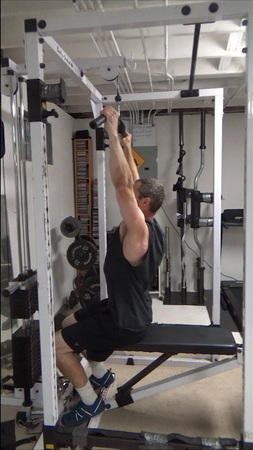
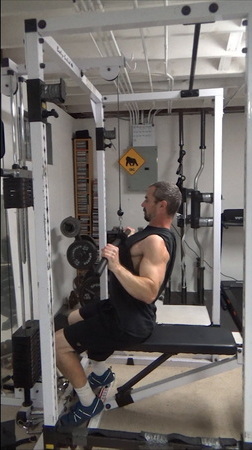
Then you will lean back, holding the bar in place in space.
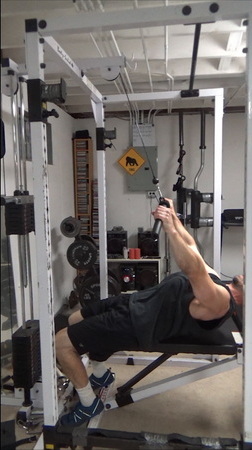
Then perform a horizontal pull targeting your upper back.
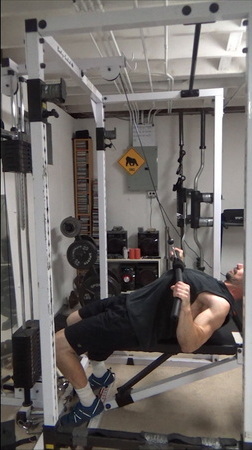
Don't use ANY momentum when you're switching pulling positions...we want a controlled movement.
This change in body position on the pulls works almost every muscle in your back (aside from lower back) in each rep.
It's like doing a lengthened-shortened superset for the same muscles within the same rep.
The start of the lat pulldown is a good stretch position for the lats... then by the time you finish the horizontal pull, you're upper back (and lats) will be put into a good shortened/contracted position.
The alternating pattern forces the scapulae to elevate, depress, retract, downwardly rotate, and slightly upwardly rotate all in a single rep.
You can even think of it like a mechanical superset done in the course of each rep.
This exercise is more suitable to training where your focus is on mechanical tension and feeling the muscles working, as opposed to true strength training where your focus is on moving the weight.
It's also not suitable as a lat isolation exercise (they're not as active in the horizontal pull part of the exercise).
I would put this exercise towards the middle or end of your back workout after you've completed your heavier training.
Use a weight your could normally get 12-15 reps with on pulldowns. When you do these, aim for 10-15 reps (meaning the combination of both pulling movements then back up) per set, really going for tight form and strong muscle contraction.
Another excellent "two phase" exercise is the Two Phase Decline Dumbbell Row.
---
Are you 40...50...60 or even 70+ years old and want to build muscle and strength like you did 20 years ago?
If you feel like you're fighting a losing battle, you're ready to discover the REAL secret to REVERSING muscle loss due to aging...
*** You need to train the body systems that SUPPORT your muscle mass, not just the muscle itself. ***
These underlying support systems diminish as you age, which is why you lose muscle as you get older no matter how hard you train... but with strategic training, these systems can be regenerated.

Share This Page...
Want More Exercises Like This?
You'll find them here...
 Support